In 2025, CJ CheilJedang sold more food abroad than at home for the first time: 5.92 trillion won overseas against 5.60 trillion won domestically, a gap of 327 billion won. The same shift is visible across Korean noodles, and it is playing out differently in Europe and the United States.
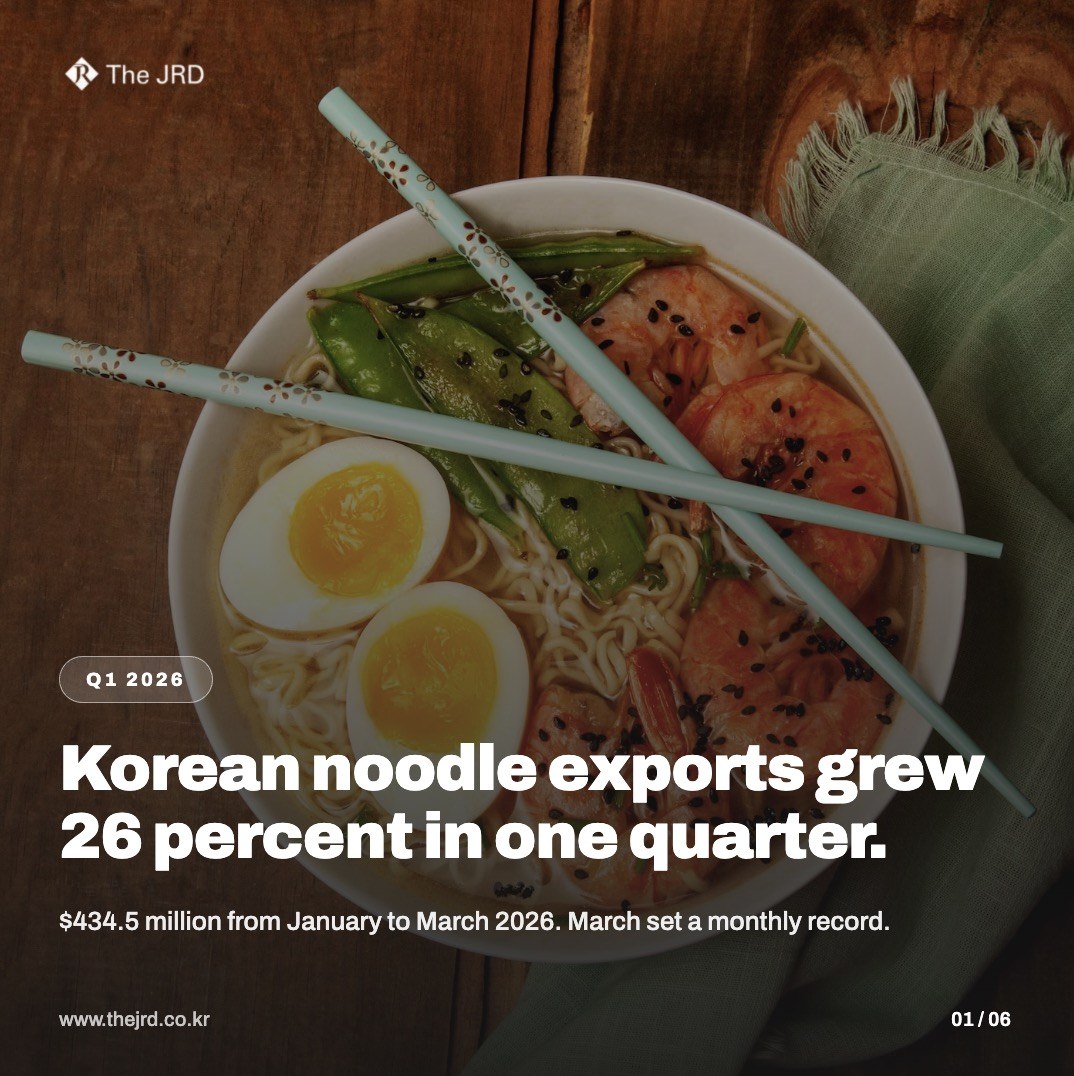
Korean noodle exports grew 26% in a single quarter, reaching $434.5 million from January to March 2026, and March set a monthly record. This is a category adding volume, not just headlines.
Samyang's Europe sales grew 215%, to 77 billion won in the first quarter of 2026, after a new UK entity and mainstream listings in Germany and the Netherlands. Europe's answer has been shelf space: the product stayed the same, and the distribution changed.
Samyang built a product only for the US market: Buldak sauce in boxed macaroni, an American format, in sweet corn and carbonara, sold only at Walmart through autumn 2026. The US answer has been a new product rather than new shelves.
Because the barrier is different in each market. Europe's constraint was availability, so distribution solved it. The US already knows the brand, so the constraint is format familiarity: putting a Korean flavour inside an American pantry staple removes the cooking-unfamiliarity barrier entirely.
Yes. Asian grocery sales in the US went from $1.57 billion in 2021 to $2.31 billion this year, and sauces, condiments, and frozen are leaving the international aisle to sit beside their American counterparts. Placement, not just availability, is what changed.
Two markets, two different answers, one company. A supplier that can do both — support a mainstream listing in Europe and co-develop a market-specific format for a US national account — is a different kind of partner from one that only ships an existing SKU.
$434.5 million from January to March 2026, up 26% on the prior quarter, with March the highest month on record.
Germany and the Netherlands, following mainstream listings and the creation of a new UK entity.
Boxed macaroni is an American pantry format. Putting a Korean sauce inside a familiar format lets a shopper try the flavour without learning a new dish.

