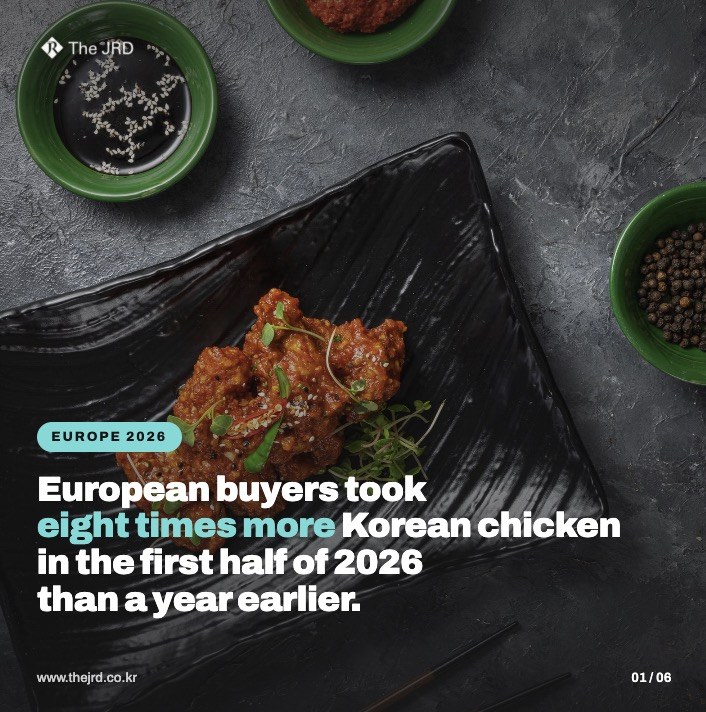
European buyers took eight times more Korean chicken in the first half of 2026 than a year earlier. The base was small. The direction is not, and what it signals is a change in how Korean fried chicken reaches Europe at all.
Korean chicken exports to the EU and UK combined rose from $630,000 in the first half of 2025 to $5.2 million in the first half of 2026. In absolute terms it is a small category; in trajectory it is the fastest-moving Korean protein line into Europe.
As dakgangjeong, chicken dumplings, and sausages: packed for shelves, not for kitchens. That distinction matters, because a product packed for retail can be listed, replenished, and forecast, while a restaurant dish cannot.
Maniker F&G sent its first frozen dakgangjeong for the UK out of its Yongin plant. A dedicated plant shipping a frozen retail format is the step that turns a foodservice phenomenon into an exportable SKU.
Yes. Boneless fried chicken is a designated item at SIAL Paris, 17 to 21 October 2026, where 89 Korean firms will exhibit — the largest Korean turnout at the show yet. Designation puts the category in front of European buyers as a category, not as individual suppliers.
Korean fried chicken is becoming something a buyer can list rather than only something a guest orders. The sourcing question moves from menu interest to supply reality: frozen capacity, EU compliance, and consistent format across dakgangjeong, dumplings, and sausage lines.
Korean fried chicken pieces coated in a sweet-and-spicy glaze, traditionally served hot but now produced in frozen retail formats for export.
Increasingly. Frozen retail formats are the entry route, and the first UK shipments of frozen dakgangjeong went out in 2026.
The category only recently moved into a retail-ready frozen format. Growth is coming off a base of $630,000, so the percentage is large while the absolute value remains early-stage.

