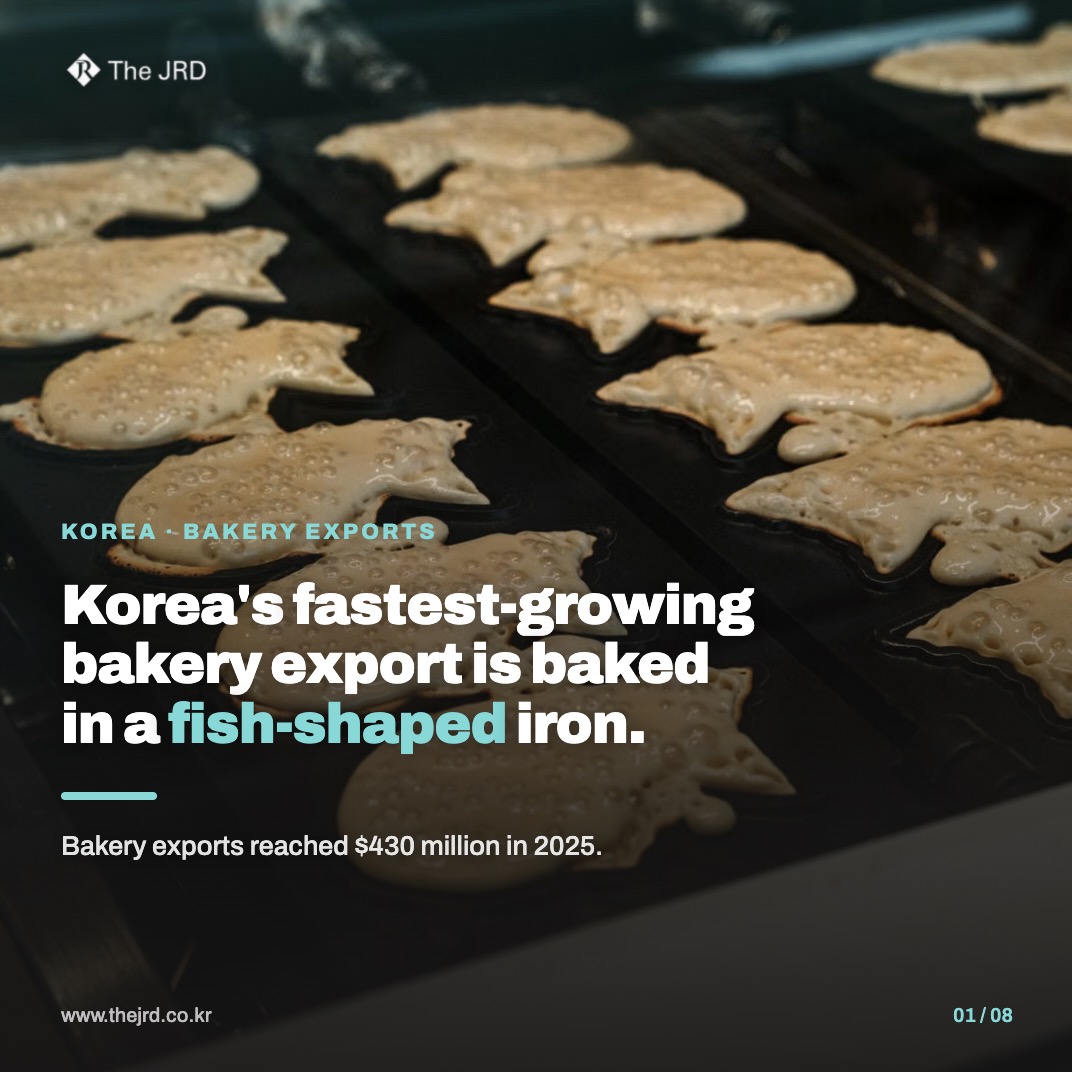
When Korean customs looked at which baked goods were lifting the country's export numbers, two of the products it pointed to were a fish-shaped pastry and a steamed bun.
Bungeoppang is a sweet red bean filling baked inside a hinged fish-shaped iron, and hoppang is a steamed bun with a savoury or sweet centre. Neither has a direct equivalent on a Western shelf. Both appeared in reporting on the Korea Customs Service briefing on bakery exports in December 2024, which identified them among the items behind the category's growth (Asia Economy). As of that December 2024 briefing, Korean bakery exports stood at 404 million dollars on a year-to-date basis (Korea Policy Briefing).
Korean bakery exports reached 430 million dollars in 2025, placing the category behind ramyeon and laver among the country's food exports (Samil PwC, citing Korea Customs Service trade statistics). Sauces sat close behind at 420 million dollars, so the ranking between the two is narrow rather than settled. For context, total K-Food+ exports were 13.62 billion dollars in 2025 (Ministry of Agriculture, Food and Rural Affairs).
Yes. Bakery exports grew 7.9 percent a year from 2017, against 5.8 percent a year for K-Food exports as a whole (Samil PwC). The first quarter of 2026 added a further 17 percent. The wider category is moving in the same direction: K-Food+ exports passed 10 billion dollars on 10 September 2026, 253 days into the year, according to the Korea Agro-Fisheries and Food Trade Corporation in a 14 September announcement (Financial News). First-half 2026 exports stood at 7.05 billion dollars (MAFRA).
The United States took 32.6 percent of Korea's bakery exports in 2025, ahead of China at 16.0 percent and Japan at 4.9 percent (Samil PwC). US placement is already visible at the retail level. SPC Samlip has sold yakgwa, a fried honey pastry, through Costco since December 2024 (Electronic Times). Yakgwa is made with wheat flour, sesame oil and honey or rice syrup, fried and then soaked in syrup, which gives it a texture with no close analogue in Western baking.
Format matters because it is the harder thing to copy. A new flavour is a recipe change on an existing production line. A new shape is a new mold, a new line and a new supplier decision, which is why format-led categories tend to stay with the manufacturers that already build for them. We saw the same pattern with frozen kimbap, where two US retailers went to two different Korean manufacturers rather than reformulating a domestic product. In the United States, taiyaki soft serve chains such as SomiSomi have already built consumer familiarity with the fish-shaped form.
Mochi ice cream gives a useful benchmark, and the move took years rather than seasons. The format travelled from Japan to American production lines gradually, and by May 2018 the brand then trading as My/Mo reported placement in close to 10,000 US stores (FoodNavigator). Korean bakery formats are early in that same arc, which is where shelf positions are still open.
Bungeoppang is a Korean pastry baked in a hinged fish-shaped iron, usually filled with sweet red bean paste.
Korean bakery exports reached 430 million dollars in 2025, ranking just behind ramyeon and laver and close to sauces at 420 million dollars.
The United States, which took 32.6 percent of Korea's bakery exports in 2025, ahead of China at 16.0 percent.
Yakgwa is a Korean fried pastry made with wheat flour, sesame oil and honey or rice syrup, soaked in syrup after frying.

